

EVENTS
Events
Event Date: November 3, 2026, 1:00 PM – 5:00 PM
Asia Week
Academic Exchange Program by Past Laureate of Fukuoka Prize ”Inbound Tourism in Edo: tourist activities by staff of the Dutch Trading Post”
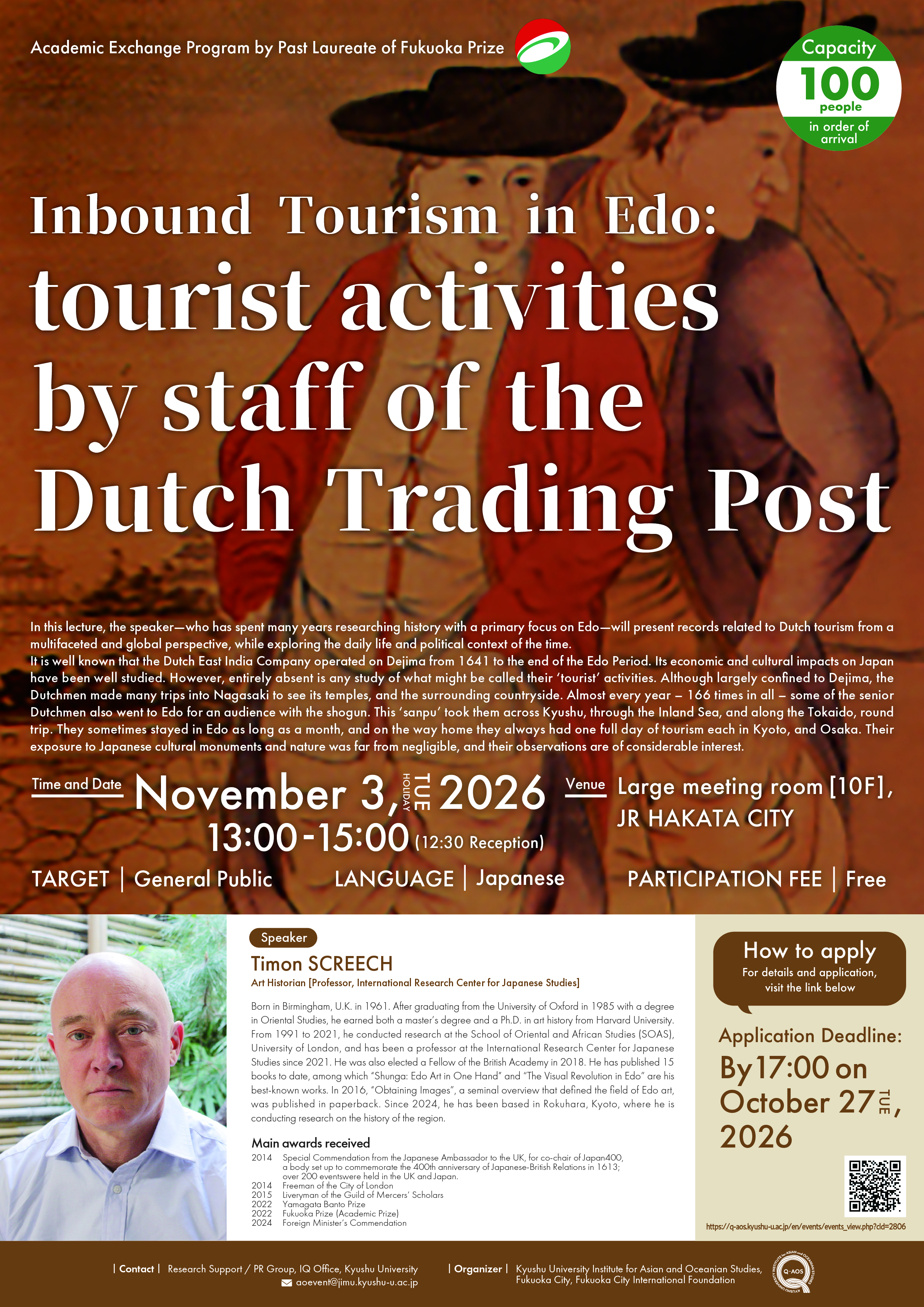
In this lecture, the speaker—who has spent many years researching history with a primary focus on Edo—will present records related to Dutch tourism from a multifaceted and global perspective, while exploring the daily life and political context of the time.
It is well known that the Dutch East India Company operated on Dejima from 1641 to the end of the Edo Period. Its economic and cultural impacts on Japan have been well studied. However, entirely absent is any study of what might be called their ‘tourist’ activities. Although largely confined to Dejima, the Dutchmen made many trips into Nagasaki to see its temples, and the surrounding countryside. Almost every year – 166 times in all – some of the senior Dutchmen also went to Edo for an audience with the shogun. This ‘sanpu’ took them across Kyushu, through the Inland Sea, and along the Tokaido, round trip. They sometimes stayed in Edo as long as a month, and on the way home they always had one full day of tourism each in Kyoto, and Osaka. Their exposure to Japanese cultural monuments and nature was far from negligible, and their observations are of considerable interest.
It is well known that the Dutch East India Company operated on Dejima from 1641 to the end of the Edo Period. Its economic and cultural impacts on Japan have been well studied. However, entirely absent is any study of what might be called their ‘tourist’ activities. Although largely confined to Dejima, the Dutchmen made many trips into Nagasaki to see its temples, and the surrounding countryside. Almost every year – 166 times in all – some of the senior Dutchmen also went to Edo for an audience with the shogun. This ‘sanpu’ took them across Kyushu, through the Inland Sea, and along the Tokaido, round trip. They sometimes stayed in Edo as long as a month, and on the way home they always had one full day of tourism each in Kyoto, and Osaka. Their exposure to Japanese cultural monuments and nature was far from negligible, and their observations are of considerable interest.
Details
- Date
- 2026/11/03 13:00 ~ 2026/11/03 15:00
(Part 2: Discussion with the Speaker, 15:00 ~ 17:00)
- Venue
- JR Hakata City 10F Large meeting room
- Capacity
- 100 people
- Language
- Japanese
Venue
JR Hakata City 10F Large meeting room
(1-1, Hakataekichuogai, Hakata-ku, Fukuoka-shi, Fukuoka)
For details on access to the venue, please see the following website.
Access guide | JR HAKATA CITY/AMU PLAZA HAKATA official site (transer.com)
(1-1, Hakataekichuogai, Hakata-ku, Fukuoka-shi, Fukuoka)
For details on access to the venue, please see the following website.
Access guide | JR HAKATA CITY/AMU PLAZA HAKATA official site (transer.com)
Fukuoka Prize
Fukuoka has since antiquity played a significant role as Japan’s gateway for exchanges with the rest of the Asian region. With its unique history in mind, the Fukuoka Prize was established in 1990 through the collaboration of the City Government, academia and private businesses in order to contribute to peace, and to further understand the extraordinary cultures of the Asian region. Since then, many laureates with distinguished achievements throughout most of the Asian region have been awarded the Prize.
◆Fukuoka Prize website◆
Fukuoka Prize (fukuoka-prize.org)
◆Fukuoka Prize website◆
Fukuoka Prize (fukuoka-prize.org)
Application deadline
17:00, Tuesday, October 27th, 2026
Application form
Application Open
- Application Starts
- Open
- Application Closed
- Oct 27 2026