
EVENTS
Events
Event Date: April 8, 2026, 12:10 PM – 12:50 PM
Brown Bag Seminar
Q-AOS Brown Bag Seminar Series The 227th Seminar "The Aesthetics of Nuclear Invisibility: Nuclear Warfare and Its Artistic Afterlives"
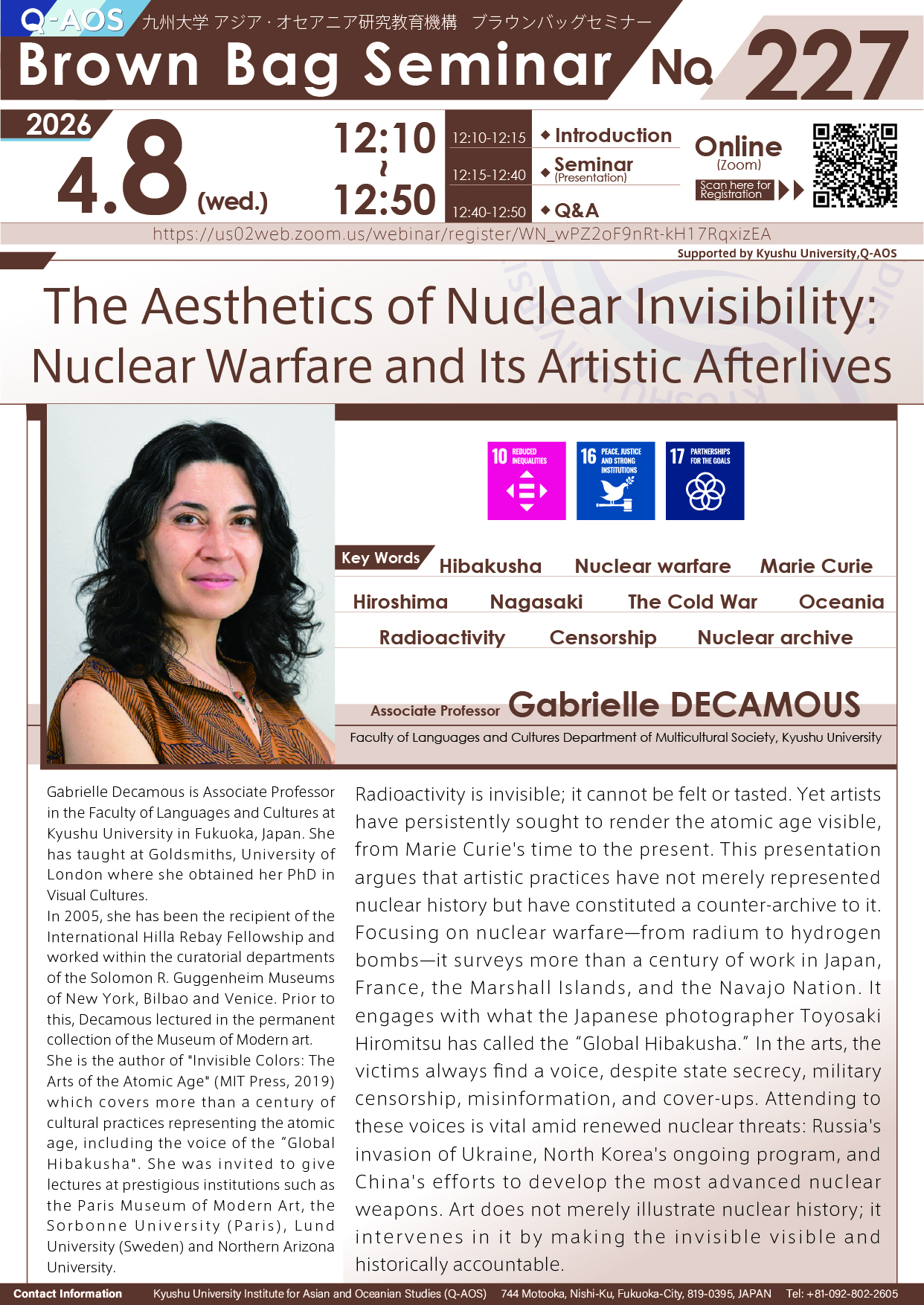
The Q-AOS Brown Bag Seminar Series will start every Wednesday at lunchtime from April 2021. The purpose of this webinar series is to provide opportunities not only to learn research related to SDGs in Asian and Oceanian regions, but also to expand your research network across different academic areas.
The webinar is free, available in English and Japanese, and open to everyone! We hope you all come and join us!
The webinar is free, available in English and Japanese, and open to everyone! We hope you all come and join us!
Details
- Date
- 2026/4/8 12:10-12:50
- Style
- Zoom Webinar
- Language
- Bilingual Japanese-English support (simultaneous interpretation)
- Admission Fee
- Free
- The maximum number for the webinar participants
- 500 people
- Contact
- Kyushu University Q-AOS Administrative Office
TEL:+81-92-802-2605
E-mail:aoevent★jimu.kyushu-u.ac.jp
(Please change ★ to @)
Abstract
Radioactivity is invisible; it cannot be felt or tasted. Yet artists have persistently sought to render the atomic age visible, from Marie Curie's time to the present. This presentation argues that artistic practices have not merely represented nuclear history but have constituted a counter-archive to it.
Focusing on nuclear warfareーfrom radium to hydrogen bombsーit surveys more than a century of work in Japan, France, the Marshall Islands, and the Navajo Nation. It engages with what the Japanese photographer Toyosaki Hiromitsu has called the “Global Hibakusha.” In the arts, the victims always find a voice, despite state secrecy, military censorship, misinformation, and cover-ups. Attending to these voices is vital amid renewed nuclear threats: Russia 's invasion of Ukraine, North Korea 's ongoing program, and China's efforts to develop the most advanced nuclear weapons. Art does not merely illustrate nuclear history; it intervenes in it by making the invisible visible and historically accountable.
Focusing on nuclear warfareーfrom radium to hydrogen bombsーit surveys more than a century of work in Japan, France, the Marshall Islands, and the Navajo Nation. It engages with what the Japanese photographer Toyosaki Hiromitsu has called the “Global Hibakusha.” In the arts, the victims always find a voice, despite state secrecy, military censorship, misinformation, and cover-ups. Attending to these voices is vital amid renewed nuclear threats: Russia 's invasion of Ukraine, North Korea 's ongoing program, and China's efforts to develop the most advanced nuclear weapons. Art does not merely illustrate nuclear history; it intervenes in it by making the invisible visible and historically accountable.
Program
12:10 – 12:15 Introduction
Associate Professor, Fumihiko YOKOTA (Q-AOS Coordinator)
12:15 – 12:40 Seminar
Title: The Aesthetics of Nuclear Invisibility: Nuclear Warfare and Its Artistic Afterlives
Speaker: Associate Professor, Gabrielle DECAMOUS (Faculty of Languages and Cultures Department of Multicultural Society)
12:40 – 12:50 Q&A
Associate Professor, Fumihiko YOKOTA (Q-AOS Coordinator)
12:15 – 12:40 Seminar
Title: The Aesthetics of Nuclear Invisibility: Nuclear Warfare and Its Artistic Afterlives
Speaker: Associate Professor, Gabrielle DECAMOUS (Faculty of Languages and Cultures Department of Multicultural Society)
12:40 – 12:50 Q&A
Material
Privacy statement
Your registration data will only be used for this webinar and the next webinar notification mails.
Future BBS
Please check here
Application Open
- Application Starts
- Mar 23 2026
- Application Closed
- Apr 08 2026